vHIT Testing
A Quick Test of All Six Canals
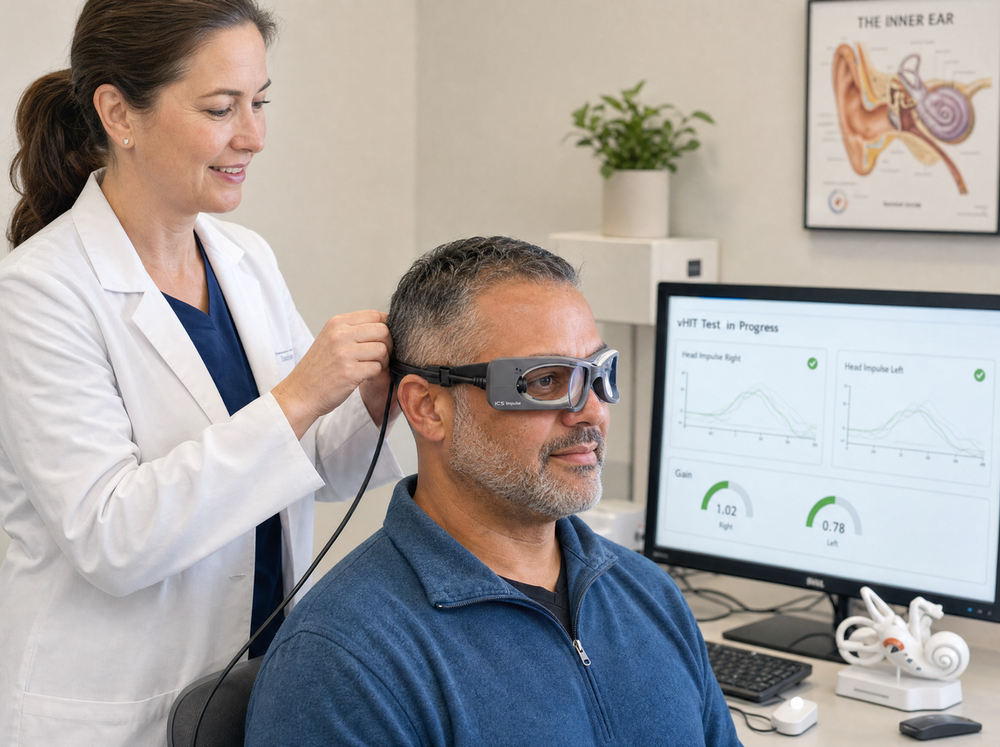
vHIT testing in Mesa, AZ uses lightweight goggles and a high-speed camera to watch your eyes while the audiologist turns your head in short, quick movements. Each direction targets a different semicircular canal, so all six can be checked individually. Nothing is put in your ear, no irrigation is involved, and the whole thing is usually finished in about 15 minutes.
Where vHIT Fits in a Balance Workup
Head turns in daily life are fast, and vHIT is the test that matches that speed. It is particularly useful right after a sudden onset of vertigo, when a physician suspects vestibular neuritis, and in patients who cannot tolerate caloric irrigation. Because our Mesa clinic also runs VNG, rotational chair, VEMP, and posturography, we can add or drop tests to fit the clinical question rather than the equipment on hand.
vHIT Testing FAQs
Common questions about video head impulse testing in Mesa, including how the head turns work, whether the test hurts, how it compares with caloric testing, and what results mean.
No. The movements are small, roughly ten to twenty degrees, and they happen quickly but gently. You keep your eyes on a dot on the wall while the audiologist supports your head and delivers the turns at unpredictable moments, which is what keeps you from anticipating them.
Speak up before the test if you have neck arthritis, a cervical fusion, or recent whiplash. In those cases the test is either modified or skipped in favor of a different measure. Otherwise there is no recovery period at all. Patients typically walk out and drive themselves home rather than needing someone to collect them.
They probe the same organ at opposite ends of the frequency range. Caloric testing works at very low frequencies and evaluates only the horizontal canal, one ear at a time. vHIT works at the high frequencies your head actually produces when you walk, drive, or turn to a voice, and it assesses all six canals.
Neither replaces the other, and a normal vHIT alongside an abnormal caloric result is a meaningful finding rather than a contradiction. Ordering both is common in our Mesa clinic, and the interpretation your physician receives explains how the two fit together for your symptoms.
An abnormal result usually shows up as a catch-up eye movement, a small corrective flick the eyes make because they lagged behind the head turn. Which direction produces it points to the affected canal and side, and the measured gain puts a number on how much function is reduced.
What that means for you depends on the rest of the picture. A one-sided loss after a sudden vertigo episode often reflects an inner ear infection or inflammation, and many people compensate well over weeks with the right exercises. Reduced function on both sides raises different questions, including medication history. Your referring physician uses the report to decide the next step, and we are happy to answer questions about the recording itself.
Preparation is minimal. Come with clean skin around the eyes and skip eye makeup, since the goggles track your pupils with an infrared camera and mascara or liner can blur the recording. Contact lenses are usually fine, but bring your glasses as a backup in case we ask you to remove them.
Tell us in advance about any neck problem, recent injury, or cervical surgery so the head turns can be modified or replaced with another measure. Otherwise, take your regular medications unless your physician has said not to, and bring your insurance cards, photo ID, and the order from your referring provider. Call (480) 265-8067 if anything is unclear.
The AFA Promise to Every Patient
Whether you're here for a balance evaluation, a diagnostic hearing test, or a new set of hearing aids, you'll be cared for by credentialed clinicians using the same equipment that draws physician referrals from across the East Valley. Every new hearing aid fitting also includes a 45-day trial period, so you can wear your devices through real life in Mesa before you commit.
Patient Stories
See what Mesa and East Valley patients say about the balance testing and hearing care they received at AFA.
Answers for Dizziness and Hearing Loss in Mesa
Advanced balance testing and audiology care on Baseline Road, with most referrals seen within days.
Serving Mesa & the East Valley
Audiologist in Mesa, AZ
Our Mesa office on Baseline Road houses the full vestibular battery — rotational chair, posturography, VNG, vHIT, and VEMP — alongside complete diagnostic hearing care.
- Rotational chair and posturography, rare in Arizona
- Doctor of Audiology care at every step
- VA Community Care, Medicare, and AHCCCS accepted
- Referral appointments within days, sometimes same-day
- All major hearing aid brands, verified with Real Ear
- Serving Mesa and the East Valley since 2013
“Very helpful and willing to educate on what they’re doing as they go and make sure you understand, very patient highly recommend 😊 Went in very nervous, left feeling educated knowledgeable…”— Jon Howard, Google Review
AFA Balance & Hearing Institute
4838 E. Baseline Road, Suite #126, Mesa, AZ 85206
| Monday | 8:00 AM - 4:30 PM |
| Tuesday | 8:00 AM - 4:30 PM |
| Wednesday | 8:00 AM - 4:30 PM |
| Thursday | 8:00 AM - 4:30 PM |
| Friday | 8:00 AM - 4:30 PM |
| Saturday | Closed |
| Sunday | Closed |
Closed daily from 12:00 PM to 1:00 PM.
Get directions