
VEMP Testing
What a VEMP Test Checks in the Inner Ear
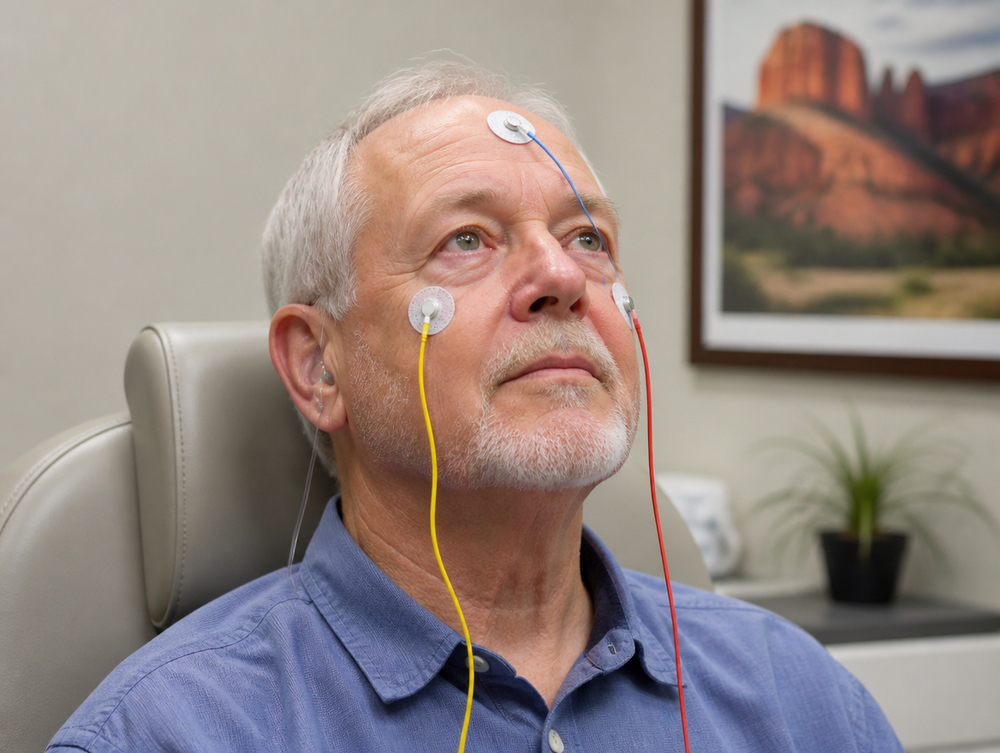
VEMP testing in Mesa, AZ measures a reflex most balance tests never touch. Short bursts of sound played into the ear trigger a tiny muscle response, recorded through surface electrodes placed on your neck or under your eyes. The pattern tells our audiologist whether the saccule, the utricle, and the inferior and superior vestibular nerves are doing their job. You stay seated the whole time.

Conditions a VEMP Can Help Identify
Abnormal VEMP results point toward specific problems rather than general dizziness. The test is central to identifying superior canal dehiscence, and it also helps evaluate perilymph fistula, enlarged vestibular aqueduct, and Meniere's disease. Physicians across the East Valley send patients here for it because cervical and ocular VEMP sit alongside the rest of the balance battery in the same Mesa clinic, on the same day.
VEMP Testing FAQs
Common questions about VEMP testing in Mesa, including what the sound bursts feel like, why electrodes go on your neck, how the results are used, and how to prepare.
Most people describe it as odd rather than unpleasant. After the skin is cleaned, a few adhesive electrodes are placed on your neck, forehead, and sometimes just below the eyes. You then hear loud clicking or tone bursts through an earphone while holding a simple position, usually lifting your head slightly or looking upward.
The muscle contraction is what the machine is recording, so mild neck fatigue is normal by the end. Each ear takes only a few minutes, and there is no dizziness afterward. Tell your audiologist if you have neck problems, limited range of motion, or a recent injury, because the position can be modified. Nothing about the test restricts your activity for the rest of the day.
They measure different parts of the same system. A VNG evaluates the horizontal canals and the pathways that control eye movement. A VEMP looks at the otolith organs and the nerves that serve them, which a VNG cannot reach. When symptoms include sound-induced dizziness, pressure sensitivity, or hearing your own voice and footsteps unusually loudly, a VEMP is often the test that explains why.
In practice the two are frequently ordered together as part of one balance workup. Doing both at a single Mesa appointment saves you a second trip and gives the interpreting audiologist a fuller picture before the report goes back to your physician.
Preparation is light compared with a VNG. Eat normally, take your usual medications unless your physician says otherwise, and skip lotion or heavy makeup on your neck and forehead so the electrodes stick well. Wearing a shirt with a wide or open collar makes the setup easier.
Bring your hearing history if you have one, since a VEMP relies on loud sound and we check your ears first. Let the office know in advance about a perforated eardrum, recent ear surgery, or a neck condition, because any of those can change how the test is run. Questions before your visit can go to (480) 265-8067.
VEMP is one of the strongest indicators. In superior canal dehiscence, a thin spot or opening in the bone above the superior semicircular canal creates a third mobile window in the inner ear, and the reflex responds at unusually low sound levels with unusually large amplitudes. That signature is what the test looks for.
A diagnosis is not made on VEMP alone. Results are read alongside your symptoms, hearing test, and usually a high-resolution CT ordered by your physician, since imaging confirms the bony defect. What our report does is tell the referring ENT or neurologist whether the physiology supports the suspicion, which is often what determines whether imaging is worth ordering at all.
The AFA Promise to Every Patient
Whether you're here for a balance evaluation, a diagnostic hearing test, or a new set of hearing aids, you'll be cared for by credentialed clinicians using the same equipment that draws physician referrals from across the East Valley. Every new hearing aid fitting also includes a 45-day trial period, so you can wear your devices through real life in Mesa before you commit.
Patient Stories
See what Mesa and East Valley patients say about the balance testing and hearing care they received at AFA.
Answers for Dizziness and Hearing Loss in Mesa
Advanced balance testing and audiology care on Baseline Road, with most referrals seen within days.
Serving Mesa & the East Valley
Audiologist in Mesa, AZ
Our Mesa office on Baseline Road houses the full vestibular battery — rotational chair, posturography, VNG, vHIT, and VEMP — alongside complete diagnostic hearing care.
- Rotational chair and posturography, rare in Arizona
- Doctor of Audiology care at every step
- VA Community Care, Medicare, and AHCCCS accepted
- Referral appointments within days, sometimes same-day
- All major hearing aid brands, verified with Real Ear
- Serving Mesa and the East Valley since 2013
“Very helpful and willing to educate on what they’re doing as they go and make sure you understand, very patient highly recommend 😊 Went in very nervous, left feeling educated knowledgeable…”— Jon Howard, Google Review
AFA Balance & Hearing Institute
4838 E. Baseline Road, Suite #126, Mesa, AZ 85206
| Monday | 8:00 AM - 4:30 PM |
| Tuesday | 8:00 AM - 4:30 PM |
| Wednesday | 8:00 AM - 4:30 PM |
| Thursday | 8:00 AM - 4:30 PM |
| Friday | 8:00 AM - 4:30 PM |
| Saturday | Closed |
| Sunday | Closed |
Closed daily from 12:00 PM to 1:00 PM.
Get directions