
Posturography
How Posturography Tests Your Balance System
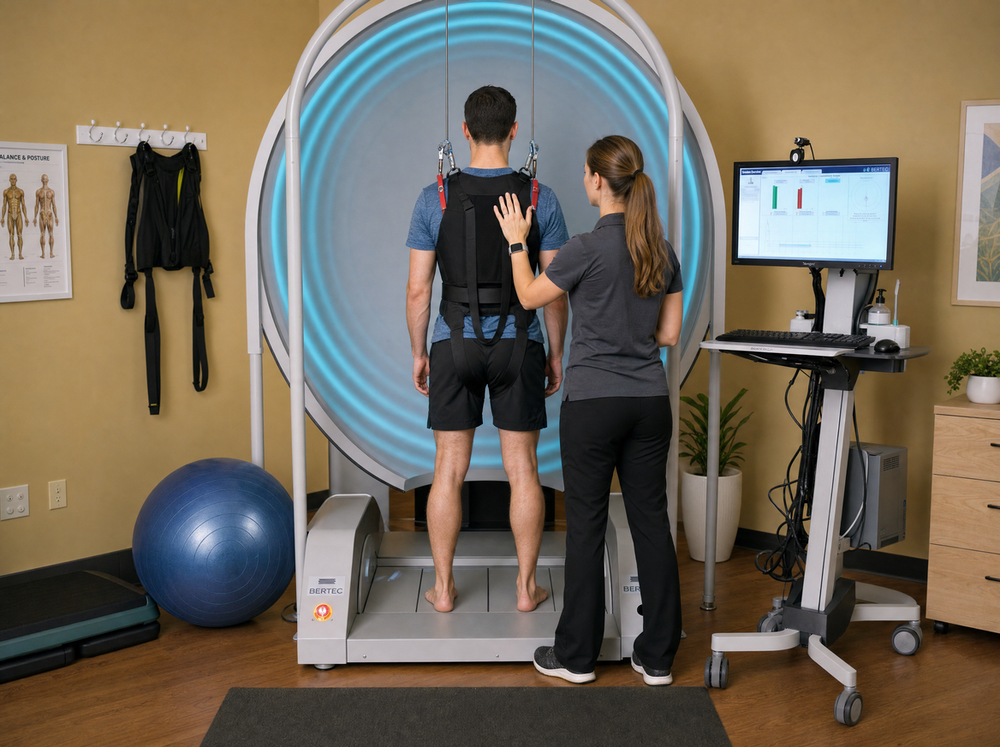
Posturography testing in Mesa, AZ puts your balance to work instead of measuring the inner ear at rest. Wearing a safety harness, you stand on a movable platform while the floor and the visual surround shift in small, controlled ways. Sensors record how much you sway. The results separate what your eyes, your inner ear, and the sensation in your feet and joints each contribute to keeping you upright.

Fall Risk Answers Referring Providers Can Use
A patient who tests normally on paper can still be unsteady walking across a dim parking lot. Computerized dynamic posturography shows which sensory channel breaks down first, which is why primary care physicians, neurologists, and physical therapists in Mesa, Gilbert, and Chandler order it for older adults after a fall. Results give a therapist a starting point, and we send the report promptly so treatment can begin.
Posturography FAQs
Common questions about computerized dynamic posturography in Mesa, including what the platform does, whether the test is safe if you fall often, and what the scores mean.
Yes, and the design accounts for exactly that. You wear a safety harness attached above the platform the entire time, so even a complete loss of balance results in nothing worse than a supported stumble. An audiologist stands beside you throughout and can stop a trial at any point.
Losing your balance during a condition is not a failure. It is data. The pattern of which conditions you cannot hold tells us whether vision, inner ear input, or sensation from your feet is the weak link. Patients who use a cane or walker are welcome to bring it, and if standing for several short trials is not realistic, tell us when you schedule at (480) 265-8067 so we can plan the visit around it.
The sensory organization portion runs six conditions, each removing or distorting one source of information. Eyes open on a firm floor is the easy baseline. Eyes closed on a moving platform with a moving visual surround is the hardest. Your sway is scored in each condition and compared against age-matched norms.
Reading across those six scores is what makes the test useful. Someone who does well until the platform moves is relying heavily on the ankles and joints. Someone who falls apart the moment the eyes close is leaning on vision to compensate for a vestibular loss. That distinction changes what therapy should target, which is why the report goes to your provider with the raw scores attached.
We handle the diagnostic side. Posturography, along with the rest of the vestibular battery, identifies what is wrong and how it affects your stability. For benign paroxysmal positional vertigo we also perform canalith repositioning in the office, often on the day of diagnosis.
Ongoing vestibular rehabilitation is a physical therapy service, so patients who need a course of exercises are referred to a therapist we trust in the East Valley. They receive the same detailed report your physician gets, which means the therapy plan starts from measured findings rather than a guess. Retesting later is a straightforward way to document progress.
Wear comfortable clothing you can move in, along with flat, supportive shoes, since testing is done with your shoes on in almost every case. Skip skirts and anything restrictive around the waist, because the harness fastens there.
Bring your glasses if you wear them for distance, and let us know about recent surgery, back or hip pain, or a leg injury that limits standing. The test itself takes about 30 minutes, and there are no dietary or medication restrictions unless your physician has combined it with a VNG on the same day. Our office is at Suite #126 on East Baseline Road in Mesa.
The AFA Promise to Every Patient
Whether you're here for a balance evaluation, a diagnostic hearing test, or a new set of hearing aids, you'll be cared for by credentialed clinicians using the same equipment that draws physician referrals from across the East Valley. Every new hearing aid fitting also includes a 45-day trial period, so you can wear your devices through real life in Mesa before you commit.
Patient Stories
See what Mesa and East Valley patients say about the balance testing and hearing care they received at AFA.
Answers for Dizziness and Hearing Loss in Mesa
Advanced balance testing and audiology care on Baseline Road, with most referrals seen within days.
Serving Mesa & the East Valley
Audiologist in Mesa, AZ
Our Mesa office on Baseline Road houses the full vestibular battery — rotational chair, posturography, VNG, vHIT, and VEMP — alongside complete diagnostic hearing care.
- Rotational chair and posturography, rare in Arizona
- Doctor of Audiology care at every step
- VA Community Care, Medicare, and AHCCCS accepted
- Referral appointments within days, sometimes same-day
- All major hearing aid brands, verified with Real Ear
- Serving Mesa and the East Valley since 2013
“Very helpful and willing to educate on what they’re doing as they go and make sure you understand, very patient highly recommend 😊 Went in very nervous, left feeling educated knowledgeable…”— Jon Howard, Google Review
AFA Balance & Hearing Institute
4838 E. Baseline Road, Suite #126, Mesa, AZ 85206
| Monday | 8:00 AM - 4:30 PM |
| Tuesday | 8:00 AM - 4:30 PM |
| Wednesday | 8:00 AM - 4:30 PM |
| Thursday | 8:00 AM - 4:30 PM |
| Friday | 8:00 AM - 4:30 PM |
| Saturday | Closed |
| Sunday | Closed |
Closed daily from 12:00 PM to 1:00 PM.
Get directions